





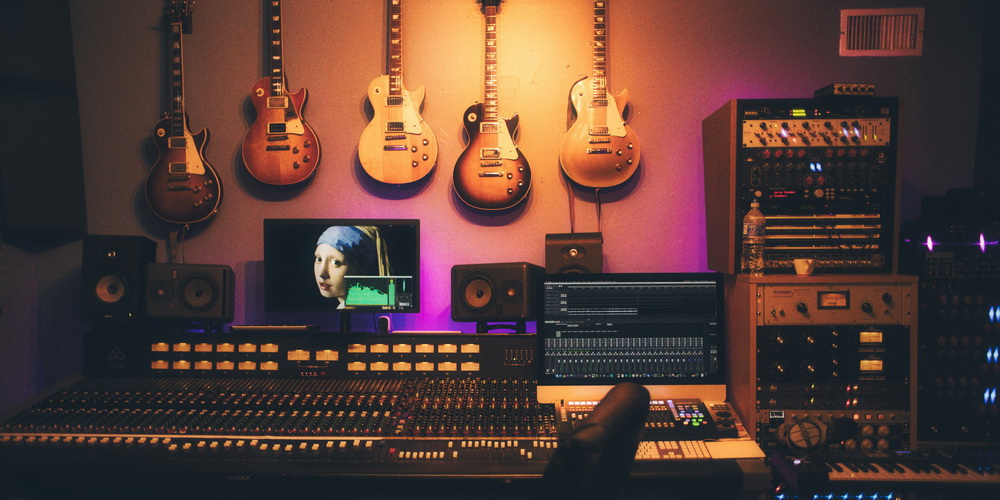
For many people in the entertainment industry, adding a studio to their home is an important step.
Whether you’re converting a spare room, adding a garden building or renovating a loft, you’ll be making a significant investment in your music or media career.
That’s why it’s essential to understand all of the UK tax consequences of paying for and owning your home studio, including what can be deducted for tax purposes. Many of the rules are complex and specific.
Read on for guidance from our experts in personal tax, business tax and VAT on the areas you should be thinking about.
Personal tax
Chris Smith, Private Client Tax Director
Meeting the conditions for capital gains tax relief on selling your home
If your longer-term plans including selling your main home, it’s worth understanding Principal Private Residence Relief (PPR) and how it could be affected by your home studio.
When you sell your main home, there are conditions for claiming PPR relief so that no CGT is payable on the gain. The third of these conditions is relevant to home offices and studios:
- The property has been your only or main residence during ownership
- You have actually lived there (occupation) during the ownership period
- No part of the property has been used exclusively for business purposes
PPR can also cover part of the garden and buildings within a permitted area (generally up to 0.5 hectares).
Whether your home studio affects PPR depends on how it’s used.
If the studio space is used exclusively for business, HMRC can treat that part of the property as not qualifying for PPR relief. You would likely have to apportion the gain between the residential part (qualifying for relief) and the business-only part (chargeable to CGT). This applies whether it’s a separate outbuilding or a room/extension.
If the space is genuinely mixed use (used for personal and business), it can still qualify as part of your residence for PPR relief. HMRC looks at actual use; any regular residential use helps preserve relief. Practical steps to help this include using the space for non-business activities (e.g. personal admin, family use).
If part of your home is treated as a business area, you typically apportion the overall gain on sale. Only the part of the gain relating to the residential use is eligible for PPR; the rest (business-only part) is subject to CGT. HMRC may decide on a reasonable apportionment (not necessarily based on floor area) to reflect the relative value of business vs residential use.
Outbuildings and annexes (separate buildings in the garden or grounds) can potentially fall under PPR if they are part of the dwelling house and used for residential purposes or enjoyment. If they’re used only for business, then that part is generally excluded from PPR.
Our three tips
- Avoid exclusive business use if you want full PPR e.g. mix personal use in the studio space
- Keep good records of personal v business use, especially if claiming mixed use
- Speak to a tax adviser early; the way the building is used over time matters
Corporation tax
Kate Gott, Corporate Tax Partner
Company funded works v personally funded works, and the impact on available tax reliefs and allowances
The tax treatment depends heavily on who is paying for the works – the company or the homeowner – and who owns the resulting structure.
Company funded works
Where the company pays for the construction or conversion of a studio at a director’s home, the availability of corporation tax relief depends on whether the company is treated as owning the relevant asset (and, for certain reliefs, whether it has the necessary interest in the land). This opens the door to certain corporation tax reliefs, but also introduces Benefit-in-Kind (BiK) considerations.
Structural and building costs
Structural costs, such as the walls, floors, roof of a building, generally don’t qualify for capital allowances.
If constructing or converting a non-residential space, such as a garden office, your company is entitled to claim Structures and Buildings Allowance (SBA) at 3% per year over 33½ years, provided the building is used for a qualifying business activity. SBA is not available for anything used as a residence, and it sits outside the plant & machinery regime.
SBA applies only to the building fabric and only where the company incurs the expenditure. Any private use risks disqualifying a claim for SBA.
Capital allowances
Most studio equipment and many fixtures, such as movable studio equipment, fitted studio furniture, and integral features such as electrical and heating systems, are considered plant & machinery (P&M). The full cost can often be deducted through first-year reliefs such as the Annual Investment Allowance (AIA) of up to £1 million per year or Full Expensing (where the relevant conditions are met)..
Where first‑year reliefs don’t apply, writing‑down allowances at 18%, reducing to 14% from 1 April 2026 (main pool) or 6% (special rate) may be available.
Ongoing deductions
General running expenses of the studio – such as insurance costs, routine repairs and maintenance (e.g. repainting, like-for-like replacements that do not amount to an improvement etc), broadband and utilities – are classified as revenue expenses. They can be deducted, to the extent of business use, as they are incurred.
Benefit-in-Kind considerations
If a company pays for significant structural works at a director’s private residence, HMRC may treat this as a BiK, creating PAYE/NIC implications. The studio could be viewed as a company asset conferring personal benefit.
The BiK can arise even if the director/employee does not use the studio personally, because HMRC may argue that improving a director’s home is itself a benefit.
Land Remediation Relief
If the company owns (or leases) the land on which the studio is built, it may be able to claim Land Remediation Relief (LRR) for dealing with certain contaminants. In a home studio context, the most likely qualifying issues are:
- Asbestos removal from an existing structure
- Japanese knotweed treatment on the site of a proposed garden studio
LRR provides a 150% enhanced deduction for qualifying expenditure and, where the company is lossmaking, the additional deduction can be surrendered for a repayable tax credit at 16%, subject to meeting the relevant conditions. Relief is only available where the company, not the individual, incurs the cost and the contamination was not caused by the company.
Personally funded works
An alternative is for the homeowner to fund the building works personally and then rent the studio space to the company.
The company can deduct rent as a revenue expense, provided the amount is commercially reasonable. However, because the company does not own the structure, it will not be eligible to claim SBA or capital allowances on the building works.
The company can still claim P&M allowances on any equipment it purchases.
VAT
Luigi Lungarella, VAT Partner
How input VAT claims can differ between pre-existing rooms, refurbishment and construction, and between business use and mixed use
Compounding the cost of setting up a home studio is the 20% UK VAT that will generally be charged on top of the price of goods and installation services.
You might be forgiven for thinking that if the home studio has a business purpose (i.e. it generates income) you could get some of that VAT back. While true in principle, it’s not always so straightforward.
It is true that, in general, input VAT is recoverable by a VAT registered business if it is directly and immediately linked to an onward taxable supply. A good example is a chocolate bar purchased wholesale for £1 + 20p VAT. If sold onwards by the VAT-registered business for £2 + 40p VAT, the business need only actually pay 20p (ie 40p – 20p). This is because the business already incurred (paid) 20p VAT upon purchase.
So too, with spend on a home studio by a VAT registered person. Input VAT incurred on the studio build should be recoverable if:
- The studio is used to create content
- That content generates income
- That income includes a VAT charge of 20% which is then paid to HMRC (assuming UK consumers of such content – but certain ‘outside-the-scope’ supplies can also carry a right to deduct input VAT)
In understanding the VAT recovery for home studios, there are four common scenarios to consider.
A. Pre-existing room – business use only
For a pre-existing room to which studio equipment is added/installed, assuming no private use is made of such equipment (or is even possible), input VAT should be recoverable in full on the equipment and installation services.
B. Pre-existing room – mixed use equipment
Where studio equipment is added to an already existing room, but the equipment installed is mixed use (i.e. business and personal use) then an apportionment should be performed., e.g. a laptop computer used in editing and publishing content and for shopping, gaming and watching films.
In this case, it is necessary to arrive at a fair and reasonable apportionment of business/personal use and only claim the amount of input VAT which fairly represents business use. A suitable method in this instance might be time spent on business/personal use. If the laptop would be used 80% of the time for business purposes, then we would expect HMRC to agree that 80% of the VAT incurred on the purchase of the computer should be recoverable.
C. Refurbishment
This is where things become more complex.
There are examples in caselaw of the Tribunals allowing input VAT recovery in respect of the refurbishment of a dwelling where that dwelling doubles as business premises of a sort. These cases tend to concern properties such as farmhouses and the Tribunals have, in the past, allowed up to 70% of the input VAT as recoverable.
A farm worker, for example, will often require a residence on the farm as a prerequisite to be able to work on the farm. HMRC may not necessarily consider a home studio as being in line with such a scenario – potentially viewing a home studio as more convenience than necessity.
In our experience, HMRC do often push back against input VAT claims on the refurbishment of dwellings (even where they concern, for example, home offices) since the refurbishment necessarily implies a personal benefit which is hard to separate from the business use.
This should not affect what was mentioned in section A and B above in relation to studio equipment. A refurbishment and fit-out has two elements. The studio equipment which has only business or mixed use should be treated as above. The refurbishment element is more complicated and should either be excluded or an apportionment agreed explicitly with HMRC.
D. Construction
Where the dwelling is an entirely new construction, the construction services may be zero-rated for VAT (depending on the building meeting all of the criteria for zero-rating). This would likely include the studio if the studio is part of the dwelling (as opposed to an outbuilding).
VAT may be incurred on the equipment, but this should be recoverable as input VAT as per sections A and B above.
Other things to consider
- Fit-outs worth more than £250,000 may require ongoing true-ups/true-downs as part of the Capital Goods Scheme (CGS)
- A person building their own home may be able to claim some VAT back under the DIY Builders’ Scheme
- Refurbishment may qualify for the reduced (5%) rate of VAT if the dwelling satisfies certain conditions (such as the vacant property condition)
Key points
- In theory, where there is genuine business use of a home studio, VAT should not represent a burden to the extent of such business use.
- In practice, setting up a home studio will almost invariably sit somewhere on a spectrum between business and personal expenditure.
- The related VAT rules are particularly complex and getting it wrong could result in significant costs by way of penalties and interest.
- We recommend seeking expert VAT advice with respect to performing a fair and reasonable apportionment, ongoing CGS adjustments and scenarios of refurbishment and construction.
How BKL can help
We have over 30 years’ specialist experience supporting people, groups and organisations across the entertainment industry – including music, media and sport. Whatever your challenges or ambitions – from establishing a home studio to tour budget accounting – we can give you swift responses and pragmatic solutions. This includes helping you to understand the taxes involved in important decisions.
For a chat about how we can help you, get in touch with Tim Gazzard or send us an enquiry.